Technology
Laser weapons against drones: physics, range and the limits of use
A laser is not a missile replacement and will not defeat everything in the air. But in a narrow corridor — a small drone, direct line of sight, under a kilometre — it offers something no other effector does: a shot without ammunition, a cost per engagement of a few dollars, and almost no debris.

Contents
What happens at the point of impactThree modes that are often confusedRange is not just one numberWhy laser is beneficial at short distancesWhere the laser failsHow a laser is integrated into an object’s defenseWhat to ask the supplierThe laser complex does not “burn through” the drone instantly. It holds the beam on the target for several seconds, during which time the energy density in the spot reaches a threshold at which the material is destroyed. At a distance of 1 km, the spot of a modern fiber laser is a few centimeters - this is enough to damage the optics, melt the housing or destroy the motor mount.
It's not just the camera and control board that are critical. For a quadcopter, it is enough to lose one blade or bearing to lose control. Therefore, the laser’s task is not to “burn the entire drone,” but to disable a specific unit in the minimum time.
What happens at the point of impact
The laser energy is absorbed by the target material and turns into heat. Efficiency depends on wavelength, surface reflectivity and power density. Metal reflects part of the radiation, plastic and composite materials heat up faster, but hold their shape less well. That is why not only direct burning, but also local loss of strength is dangerous for a small drone.
The second factor is beam stability. At a distance of a kilometer, the angular vibration of the platform, atmospheric turbulence and target movement add up to a displacement of the spot. If the tracking system does not keep the spot on the vulnerable element, the energy is dissipated throughout the body and the damage time increases. Therefore, the quality of optical-electronic tracking is more important than the “certificate” power of the source.
Three modes that are often confused
Technical specifications mix illumination, suppression and defeat. These are different modes with different ranges, different holding times and different rules of application.
- Backlight and glare. The beam overloads the optical-electronic load matrix. The drone loses its image, the operator loses its orientation. Range - up to 1.4–2 km depending on the target optics.
- Suppression A more powerful beam disables the sensor or heats the body, forcing the drone to descend or fly away. Range - up to 2–3 km.
- Defeat Concentrated energy destroys the airframe, engine or battery. Range - up to 0.4–1 km for a wearable and transportable complex, respectively.
The difference between the modes is not only in power, but also in the beam retention time. Blinding takes a fraction of a second, defeat - from a few to ten seconds, depending on the angle and material of the target.
Range is not just one number
The range of a laser depends on the state of the atmosphere more strongly than that of a radar. Rain, fog, dust and thermal haze dissipate and absorb energy. The range also depends on the size and angle of the target: the thin beam will miss if the tracking system does not keep the spot on the vulnerable element.
Therefore, in the technical specifications it is correct to indicate not the “kill range”, but a combination: power, spot diameter, retention time, weather visibility and target type. The number “1 km” means nothing without these conditions.
The laser operates confidently in the last third of the detection zone. If the radar sees the drone at 5 km, it makes sense to place the laser complex 1–2 km from the protected object: there the target has already been confirmed, and the approach time is measured in tens of seconds.
Why laser is beneficial at short distances
- Cost of a shot. Electricity is consumed, not a rocket. At the industrial rate, the cost of one exposure cycle is measured in units of dollars.
- Ammunition As long as there is power and cooling, the complex does not “empty” after several launches.
- Precision The beam affects a specific element, not an area; the risk to others is lower than that of kinetic interception.
- No debris The affected drone falls, but does not scatter into fragments, as when the warhead is detonated.
- Fast retargeting. After hitting one target, the complex is ready for the next without reloading.
These advantages come at a cost: continuous operation is limited by heat dissipation. The transported complex operates for up to 120 seconds of continuous radiation, after which a cooling pause of up to 30 minutes is required. Wearable complex - up to 20 seconds with a pause of about 30 seconds. This is not a disadvantage, but a characteristic that must be taken into account in the application scenario.
Where the laser fails
- Weather Rain, fog and dust storm reduce the range significantly. In such conditions, the laser remains the last resort.
- Swarm One complex cannot simultaneously hold dozens of targets. We need a echelon of electronic suppression and interceptors.
- Fiber optic drones They do not use a radio channel, so the ERP does not stop them. The laser works, but requires line of sight and precise tracking.
- Challenging background Glare, smoke, running engines and thermal interference make tracking difficult and reduce the likelihood of being hit.
- Safety rules The laser requires restricted zones and standard lockouts; Its use is limited near people and sensitive optics.
The laser is not a replacement for the electronic warfare layer and is not a universal answer to a swarm. This is a precision tool for the last 1000 meters.
How a laser is integrated into an object’s defense
The laser complex does not work on its own. It receives target designation from a radar or optical-electronic system, tracks the target and applies the impact according to the rules specified for the object. The quality of the aerial picture determines how much time is left for a solution.
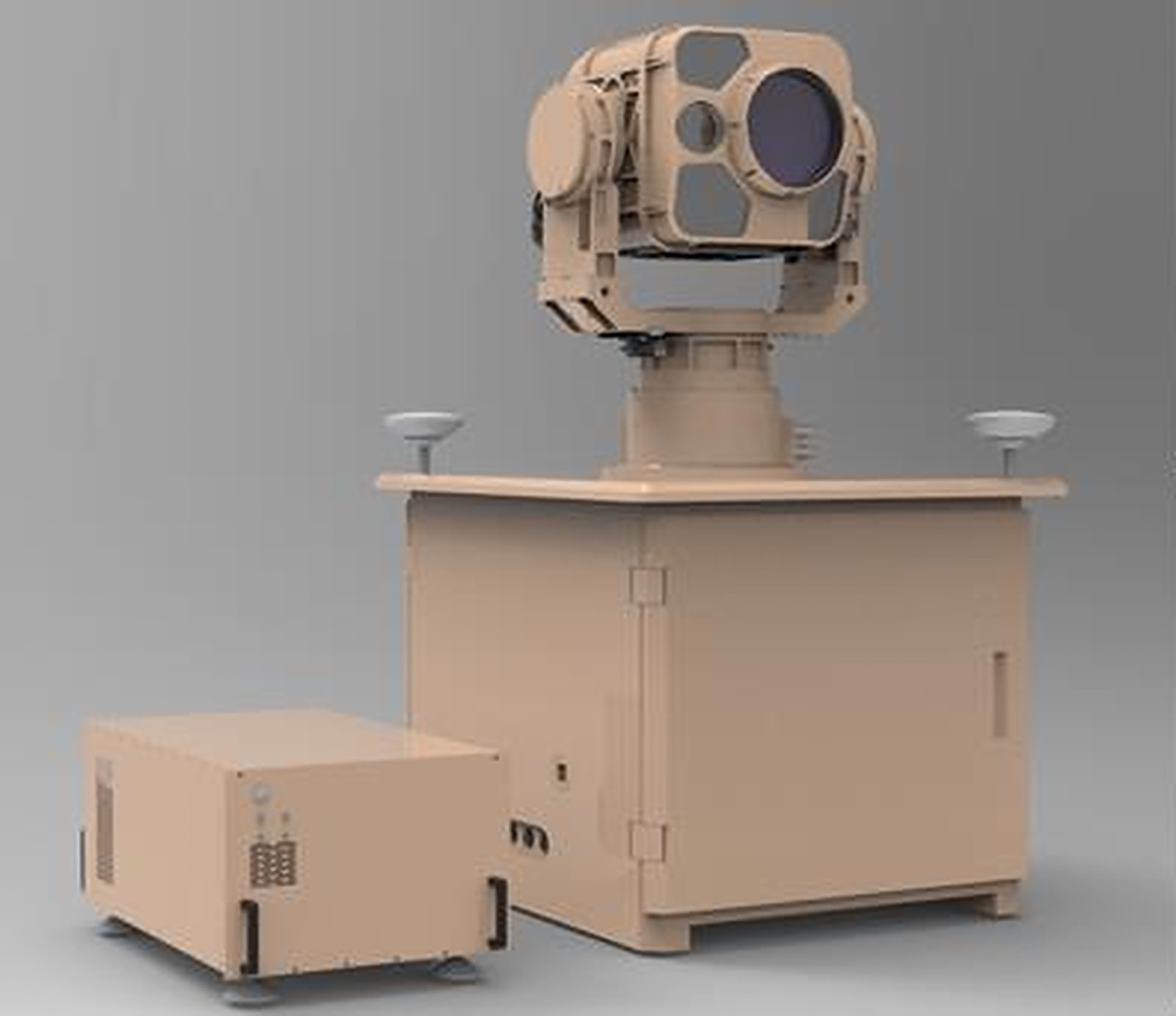
In the SENTIRA configuration, the transportable complex with a power of 3 or 5 kW operates at a range of up to 2–3 km in suppression mode and up to 0.5–1 km in destruction mode. The wearable complex with a power of 2 kW is designed for rapid deployment to remote positions: 1.4 km of suppression and 0.4 km of destruction. Both complexes use a common control loop and can operate from a fixed network or generator.
| Parameter | Portable 2 kW | Transportable 3 kW | Transportable 5 kW |
|---|---|---|---|
| EOS suppression | ≥ 1.4 km | ≥ 2 km | ≥ 3 km |
| Defeat | ≥ 0.4 km | ≥ 0.5 km | ≥ 1 km |
| Exposure time | ≥ 20 s | ≥ 120 s | ≥ 120 s |
| Weight | ≤ 30 kg | ≤ 300 kg | ≤ 300 kg |
| Nutrition | Standalone/network | 220 V | 220 V |
What to ask the supplier
- Spot diameter and beam divergence at maximum range.
- The holding time required to hit a typical target.
- Duty cycle: how many seconds the complex operates before a cooling pause.
- Consumption and type of power supply, requirements for the generator.
- Laser safety class and standard locks.
- Integration protocol with radar and EPS, and not just its own remote control.
- Results of field tests in rain and limited visibility.

