Technology comparison
Anti-drone gun vs laser on a fixed site: where each one fails
An anti-drone gun and a laser are not interchangeable products. One attacks the control or navigation channel; the other delivers optical or thermal energy to a point on the aircraft. The right choice depends on the target, the site and the acceptable consequences.

Contents
The anti-drone gun is a channel attackThe laser is a point attackWhat a fixed site changesWhere each option failsHow to compare them correctlyLogistics and operator workload decide the practical winnerSearch results often place anti-drone guns and laser weapons in the same category because both are described as directed-energy or counter-drone effectors. Operationally they are different. A jammer attempts to break a radio link or navigation signal. A laser must acquire a precise point, hold it and deliver enough energy for long enough to cause a physical effect.
The anti-drone gun is a channel attack
Most man-portable anti-drone guns emit RF energy toward the aircraft or its operator. They can disrupt control, video or GNSS reception, depending on the frequency bands and power. They are useful when the target relies on those channels and when the site permits radio transmission.
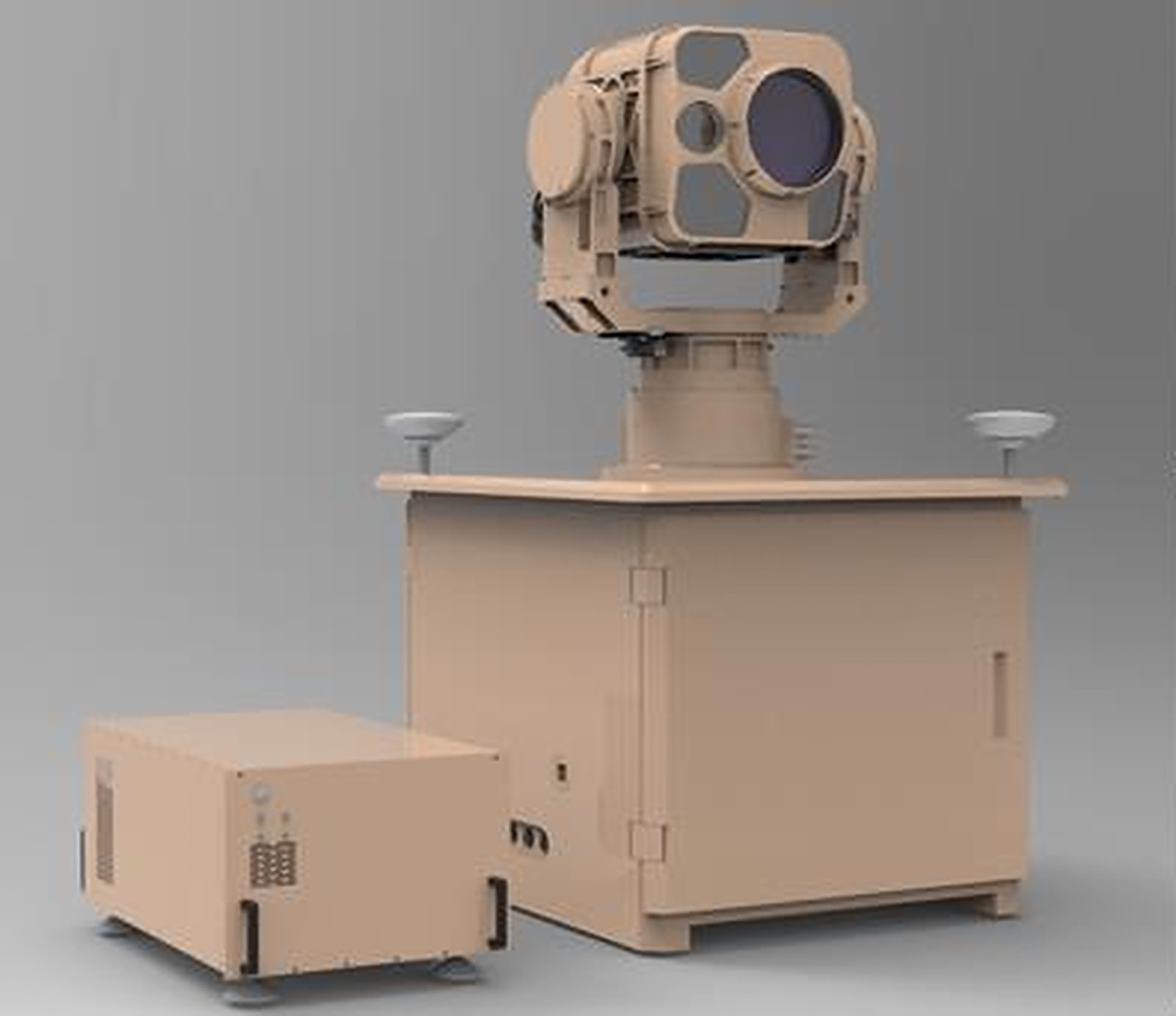
They do not automatically stop fiber-optic drones, fully autonomous aircraft or a drone whose flight controller continues after link loss. They can also create interference with nearby communications, navigation and industrial systems. The higher the site's electromagnetic sensitivity, the less attractive a wideband jammer becomes.
The laser is a point attack
A laser does not need the drone's radio channel. It needs a clear line of sight, stable tracking and enough dwell time at the selected aim point. It can affect an optical sensor, a plastic housing, a motor mount or another exposed element. Its main limitations are weather, target aspect, platform stability and safety around the beam path.
| Criterion | Anti-drone gun / jammer | Laser effector |
|---|---|---|
| Primary mechanism | RF disruption | Optical or thermal energy |
| Fiber-optic drone | May be unaffected | Potentially effective with line of sight |
| Autonomous drone | May continue after link loss | Independent of radio link |
| Site interference | Frequency and power dependent | Beam-path and eye-safety controls |
| Tracking demand | Moderate | High |
| Weather sensitivity | Lower for RF | High for rain, fog and dust |
What a fixed site changes
A fixed site adds infrastructure, bystanders, sensitive equipment and a permanent operating procedure. An anti-drone gun can be carried to a position, but a site needs a repeatable answer to who carries it, where it can be used and what happens when it is not effective. A laser can be integrated into a permanent sensor and command loop, but it requires a defined beam sector and safety area.

Where each option fails
- Gun fails when the drone is autonomous or fiber-optic, when the wrong band is targeted, or when site rules prohibit RF transmission.
- Laser fails when there is no line of sight, the tracker cannot hold the aim point, the weather attenuates the beam or the safety case cannot be closed.
- Both fail when detection is late. The best effector cannot recover time that the sensor layer did not provide.
- Both can be misused if the operator has no clear rules on confirmation, escalation and prohibited sectors.
For a fixed critical site, start with detection and tracking, then use RF or laser only where the target and site constraints allow. The effectors should complement each other, not compete for the same role.
How to compare them correctly
Do not compare a jammer's nominal range with a laser's nominal range. Ask what target, which channel or aim point, what tracking support, what environment and what allowed effect. The effective answer is a chain: detection, identification, decision, engagement and verification.
- List the drone types and flight profiles that matter.
- Decide whether RF interference is permitted at the site.
- Check line of sight and weather for a laser sector.
- Define the acceptable result for each effector.
- Test the sensor-to-effector loop, not only the effector.
Logistics and operator workload decide the practical winner
A handheld anti-drone gun looks flexible until the site has to keep it ready for every shift. Batteries, antennas, calibration and training become daily tasks. A laser looks permanent until the site has to provide power, cooling, maintenance and a safe sector. Compare the two as operating systems, not as catalogue items.
The operator also needs a clear visual and procedural model. For a gun, that means understanding frequency bands and when not to transmit. For a laser, it means holding a precise aim point and stopping if the safety conditions change. The simpler device is not necessarily the simpler procedure.